Crot Essay Part 3 – 3-Panel Comic Activity

After the X-page activity, we discuss the first eleven pages of Scott McCloud’s chapter 1, “Writing With Pictures” from Making Comics. This chapter introduces students to McCloud’s five Choices of Clarity: choice of moment, choice of frame, choice of image, choice of word, and choice of flow (10). I place class copies of the Choices of Clarity and the Transitions on each table for students to reference as we discuss them (see below).

I love including comics in my writing class. First, it takes students out of their comfort zone, as Cathy Fletcher and Sarah Andrew-Vaughan advise in Writing Outside Your Comfort Zone. Second, it requires them to revisit a memory that creates a new “synaptic connection” in their brain, per Rick Huginer, a neuroscientist and husband of one of the authors of Your Brain On Art (11). So, I have students create a three-panel comic about their childhood learning moment from the x-page activity that has them revisiting a memory that helps them think about the details and pay closer attention to the most important parts of that childhood learning moment.

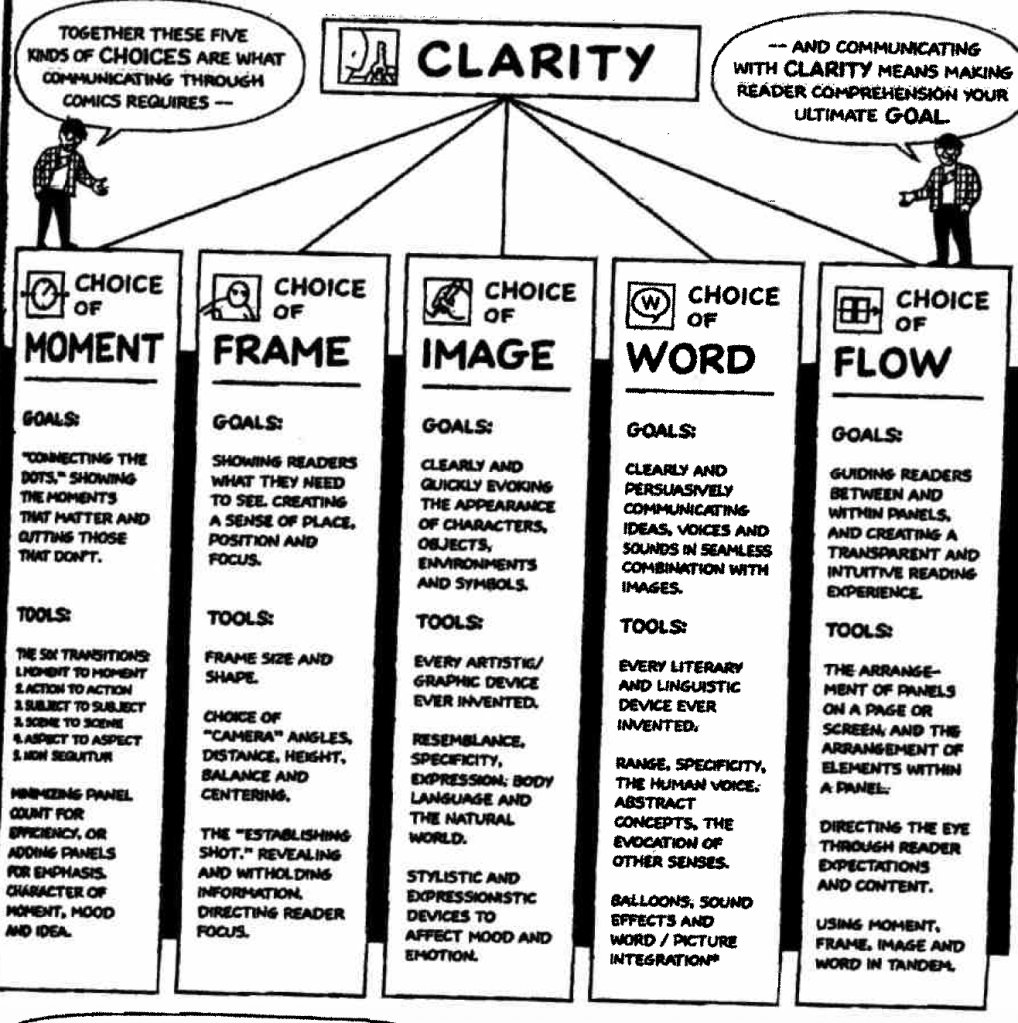
Because this is the same day as the X-page activity for their narratives, their choice of moment is already chosen, the childhood learning moment. We also discuss how these choices of clarity can relate to writing.

We then discuss the other four choices. As McCloud indicates choice of frame is like looking through a camera lens. Each panel can be close up or far away, or somewhere in between. For the choice of image, I emphasize that it is not about the drawing; I strongly encourage students to use stick figures and icons. For the choice of word, I remind them to make it as concise as possible. Last, the choice of flow for our three panels is left to right or top to bottom, depending on how they use the paper, either portrait or landscape. We then discuss how time passes between each panel using the six transitions; it will be moment-to-moment or scene-to-scene, which is a significant amount of time or space. I show them my example comic below, which illustrates a choice of moment, the first day of class. The transitions between each panel are both moment-to-moment and action-to-action. For the choice of word, I have used a thought bubble, a speech balloon, and a splash sound effect.  

3-panelComicGP.jpg

At this point, I explain that they are now going to create their own 3-panel comic, and I hand out plain paper to each student. I remind them that there are colored pencils in each group’s box that I placed on the tables at the beginning of class. I have students fold the sheet of paper in thirds to get them started. Then they write the title of the X-page Childhood Learning Moment at the top, along with their name. They have the last 15-20 minutes of class to draw.

Below is an example of a student’s first paragraph of their x-page narrative, and next to it is their 3-panel comic about that moment. At the bottom of the comic, I have then tell me what transitions they have used. This one says, subject-to-subject and scene-to-scene. I commented that it is actually moment-to-moment because scene-to-scene is a significant amount of time.
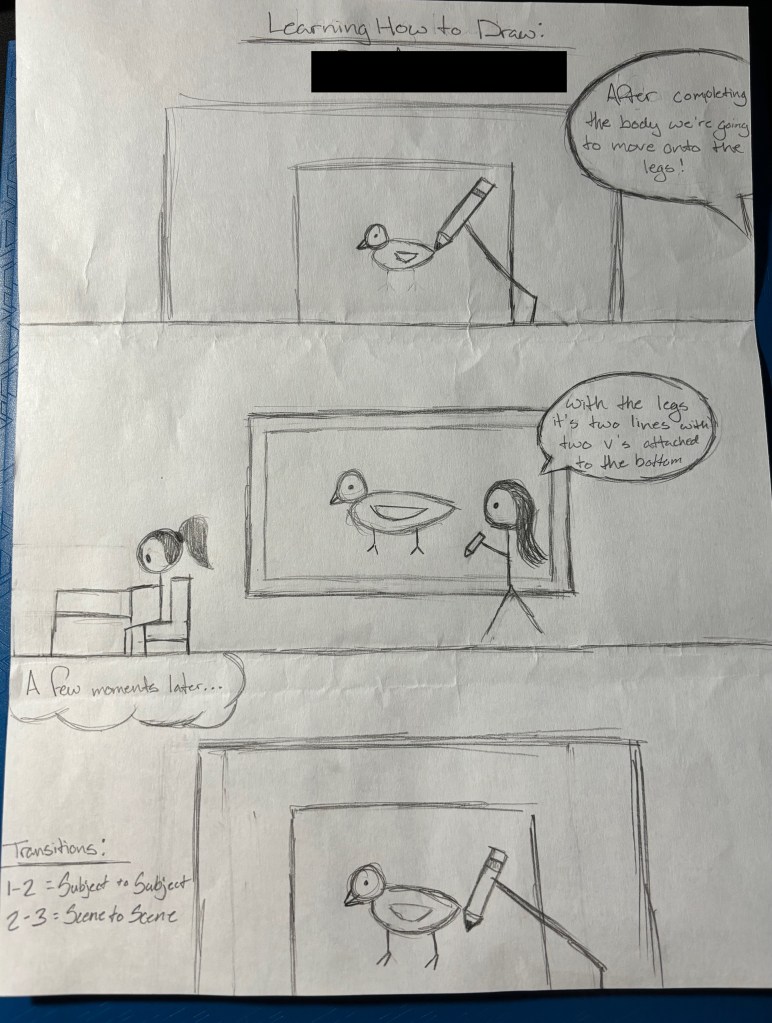
“On a sunny spring afternoon, I was sitting in my fifth grade classroom with my teacher pulling up a video on how to draw a bird. The lights were off and the bright but subtly light from the sun was coming through the window. All of us were silent as we excitingly awaited to start drawing with the paper in front of us and pencils in hand. ”


Most students will finish the comic by the time class ends; however, I give them extra time. Students take a photo of their finished comic and upload it to their Google Drive folder shared with me. When I’m assessing their “Who Am I” crot essays, I also read their comics and insert a comment. This first writing assignment is always fun to assess, and I learn a lot about my students.

Posted in Uncategorized | Tagged , , , | Leave a comment

Crot Essay Part 2

For homework for the second day, students need to finish their Childhood Learning Moments Timeline. I start my class slides with a Winston Weathers’ 1984 definition: “The crot is an obsolete word meaning a “bit’ or ‘fragment, ‘ the crot may range from one sentence to twenty or thirty . . .It is fundamentally an autonomous unit, characterized by the absence of any transitional devices” (136). Then we discuss Melinda Putz’s short article “The Crot.” Putz definition: “A crot could be a single sentence, a quotation, a proverb, a list…, a description of a scene, a dialogue, a poem.” Then we discuss Sherman Alexie’s “Unauthorized Biography of Me,” which is a crot essay. Students are put in groups of 3-4, and each group is assigned a specific page of the article. Students are given about 10-15 minutes to count the crots and decide what genre or type of writing each crot is on their assigned page. I answer questions about what I mean by genre or types of writing and remind them there is a double-space between each crot as they work together. I love seeing the lightbulbs come on. Then each group shares its findings with the class.

For instance, on the first page of the Alexie piece, there is a short bio about the author, which I bring to students’ attention. Then the first crot is a scene about Indian boys playing basketball until it’s too dark. The next crot is a thesis statement about Alexie stating he has “never met a Native American” but has “met thousands of Indians” (46). The next crot is some dialogue between Alexie and a person in the audience on why he refers to himself as an Indian. The last crot of this page is the beginning of a seven-paragraph narrative with some dialogue. The first group would tell the class there are five crots in five different genres on the first page. Each group presents their count of crots and genres to the class. By the time we go through all seven pages, the students get the idea about what a crot is, a specific type of writing such as an anecdote, scene, thesis, lists, formula, narrative, dialogue, description, lists, and even a bio of the author. They can also see that all of the crots are separated by a double white space, with no transitions. I bring to their attention that the thread or connection that holds them all together is that the crots are about Sherman Alexie. This is reflected in the title “Unauthorized Biography of Me,” just as the title of the assignment is “Who Am I?” As a first assignment, this crot essay gives me information and insight about my students.

At the end of the second class, I have students make a copy of the auto-bio poem form (see below) in our shared folder and navigate it to their Project 1 folder shared with me in Google Drive. This could also be a hard copy for students to fill out. Students have to fill in the blanks in the form with words that describe themselves. Then they use the phrases and answers to create their auto-bio poem (student example below). This poem counts as one of their 10 childhood learning moments for a first draft due for the next class.

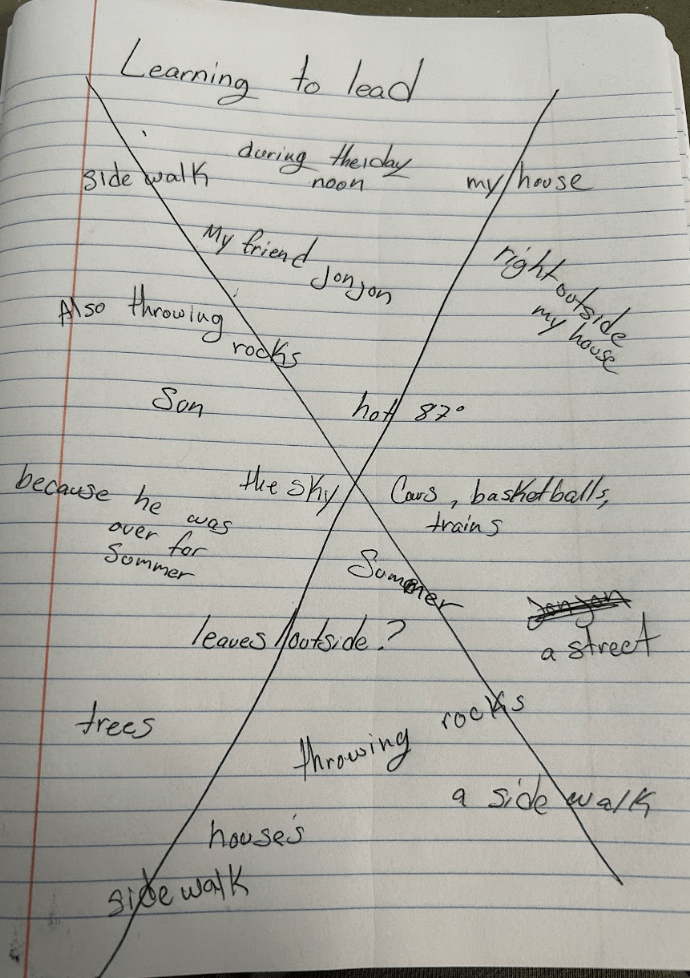
At the beginning of the third class, to help students with their 4-6 paragraph narratives, I have them do Lynda Barry’s X-page activity from Syllabus (79-81). Students open their composition books or notebooks to a blank page and draw a big X across the page. I have them put the title of the childhood learning moment at the top of the page. Then, as I read the 20 questions out loud, students write their answers anywhere on the X-page. Questions such as: Where are you? What are you doing? What season is it? Where is the light coming from? Who else is there? Etc. (student example right)

After students have answered all of the questions, I tell them to revise this learning moment using their answers to expand the narrative into 4-6 paragraphs with some dialogue. When I assess the crot essay assignment, it is easy to see if they have revised by adding their X-page answers, telling me where they are, the season it is, where the light is coming from, who is with them, etc. Here’s a Crot essay Student Example with my comments.

Also on the third day, students create a 3-panel comic about the X-page Narrative. The reading assignment for this class is the first 11 pages of Scott McCloud’s chapter one, “Writing With Pictures,” from Making Comics. In my next post, I will explain this activity and include examples.

Posted in Uncategorized | Tagged , , | Leave a comment

Teaching All Learning Types Through The Crot Essay Assignment

I gave a presentation at the Southern Regional Composition Conference in May titled “20th Century Crot Esayy Meets 21st Century Multimodality.” I wanted to write an article about this assignment, so I’m making myself write this post as the first part of a possible article.

One of my goals in teaching first-year writers starts before the semester begins with emailing students my list of 26 titles of graphic memoirs for a semester-long project. Then, for the first introductory discussion or class fast write, students take the VARK questionnaire developed in 1992 by Neil Fleming and C. Mills. Telling me what type of learner they are, if they have read a graphic memoir or novel, and what field of study they are pursuing. If you don’t know your learning style, click on the link above. Try it, then leave me a comment if you learned something new about yourself.

When I was in high school, English was not my best subject, and I can still hear my teacher telling me, “You are a creative writer; however, you need to learn the fundamentals.” I know the fundamentals are the ‘later-order concerns’ or the last part of the writing process for any piece of writing. I also learned there are multimodal literacies, not one literacy. My teaching philosophy reflects this, as I learned from Jewett & Kress when I was writing my grad project.

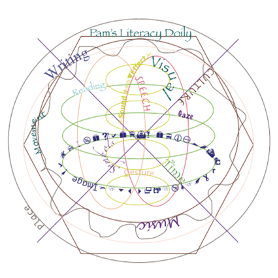
“ . . .These literacies are like an old-fashioned lace doily with threads of image, gaze, gesture, movement, speech, music, and sound effects woven in language, culture, time, and place to communicate meaning. This literacy doily will be different for every human being and will reflect each person’s learning style— visual, aural, read/write, kinesthetic, or multimodal— developing over a lifetime”(McCombs).

I’m a multimodal learner, leaning more toward the visual, as you can see in my literacy doily above, the word visual is the same size as the word writing. Per my syllabus, my students write all of their assignments in Google Drive documents, allowing them to incorporate images and hyperlinks, and share with me and fellow students for peer review comments, a digital multimodal writing experience.

On the first day, I take students out of their comfort zone by introducing them to Scott McCloud’s “Chapter 2: The Language of Comics,” from Understanding Comics, which is about “icons.” I then have students draw their iconic self, which will be incorporated into their first written assignment, the crot essay “Who Am I?” I use comics in my writing class to help level the playing field between those high-achieving read/write learners and the aural, visual, kinesthetic, or multimodal learners.

Here are a few student examples. One of my favorites is the last one above; she did not like drawing; however, she portrays her iconic self well with that one simple line for her frown. Their iconic self drawings are then incorporated into the crot essay, helping tell me a little bit about each student.

The crot essay “Who Am I?” assignment asks students to write about 10 childhood learning moments in at least 5 different genres or types of writing. To help students get started figuring out their learning moments, I have them create a childhood learning moments timeline with dates and icons, moments that shaped who they are today. I have them start with their birthday in the lower right corner and curve their way up to the top, present day. I share my example, and they begin creating theirs during class.

To help students learn what a crot essay is, for day two, I have them read Melinda Putz short article “The Crot.” Putz’s definition: “A crot could be a single sentence, a quotation, a proverb, a list…, a description of a scene, a dialogue, a poem.” They also read Sherman Alexie’s “Unauthorized Biography of Me,” which is an example of a crot essay that starts with his short bio, then a scene of Indian boys playing basketball until it is too dark, then a thesis statement, and so on. We will discuss both articles and do a group activity during the next class.

So, on the first day of class, they were introduced to Scott McCloud and drew their iconic self. They also started a childhood learning moments timeline, and they got to know some of their fellow classmate. Stay tuned for part two.

Posted in Uncategorized | Tagged , , , | Leave a comment

It’s Nice To Have Company!

I finished everything on my to-do list. It amazes me how motivated I get when company are coming to visit. I powerwashed, painted, cleaned, sewed, gardened, and mowed weeks before the visit. Then last Friday, my oldest son, Mike, and his little French Bulldog, Bo, came to visit. They arrived around dinner time. My sister came over and joined us for pulled pork sandwiches with coleslaw. Then later, he and I sat on the deck, listening to music, enjoying the cool evening breeze.

Bo and Annie had a great time together, playing tug-a-war, running around the yard, and cooling off. It was in the 90s for the entire visit, and little Bo quickly learned where the air conditioning vents were.

I had an outdoor game day planned with family and friends on Sunday, unfortunately is was 95 degrees and humid so we played one game of horseshoes and one game of cornhole and the ladies played badmitton for about ten minutes. Annie’s little pool was a hit with the ladies cooling our feet! Most of us did eat outside in the shade of my oak and silver maple trees the variety of dogs and sausages Mike grilled.

But the best fun happened in the air-conditioned house when I handed out bottles of bubbles!

The little kid inside everyone came out, and the laughing began!

Monday, Mike and I had planned to attend the Detroit Ford Fireworks. Through my research, I discovered I could pay for reserved parking. I reserved a spot that was a three-minute walk to Hart Plaza. Even though it was in the mid-nineties, there was a cooling breeze off the river. We got there around 6 pm, and the fireworks don’t start until 10. The people around us were friendly, and several had been there many times.

Time passed, the sun went down, . . . and then the fireworks began!

The lady sitting in front of us, wearing the red, white & blue hat, made for a perfect photo! With fireworks going off from three barges, it was the BEST fireworks I have experienced.

Then it was time for our company to head home. Little Bo, in the Hummer, is waiting for Mike. We all had a great time together.

Posted in Uncategorized | Tagged , , , | Leave a comment

Everything Costs $$, Even My Blog!

I used to write in my WordPress blog monthly sometimes weekly, but then I got busy teaching and just didn’t. I’ve longed to get back to blogging, so this morning I spent over an hour figuring out how to post in my WordPress.com blog. I finally ended up paying for the cheapest plan for a year, so I could add a new post!

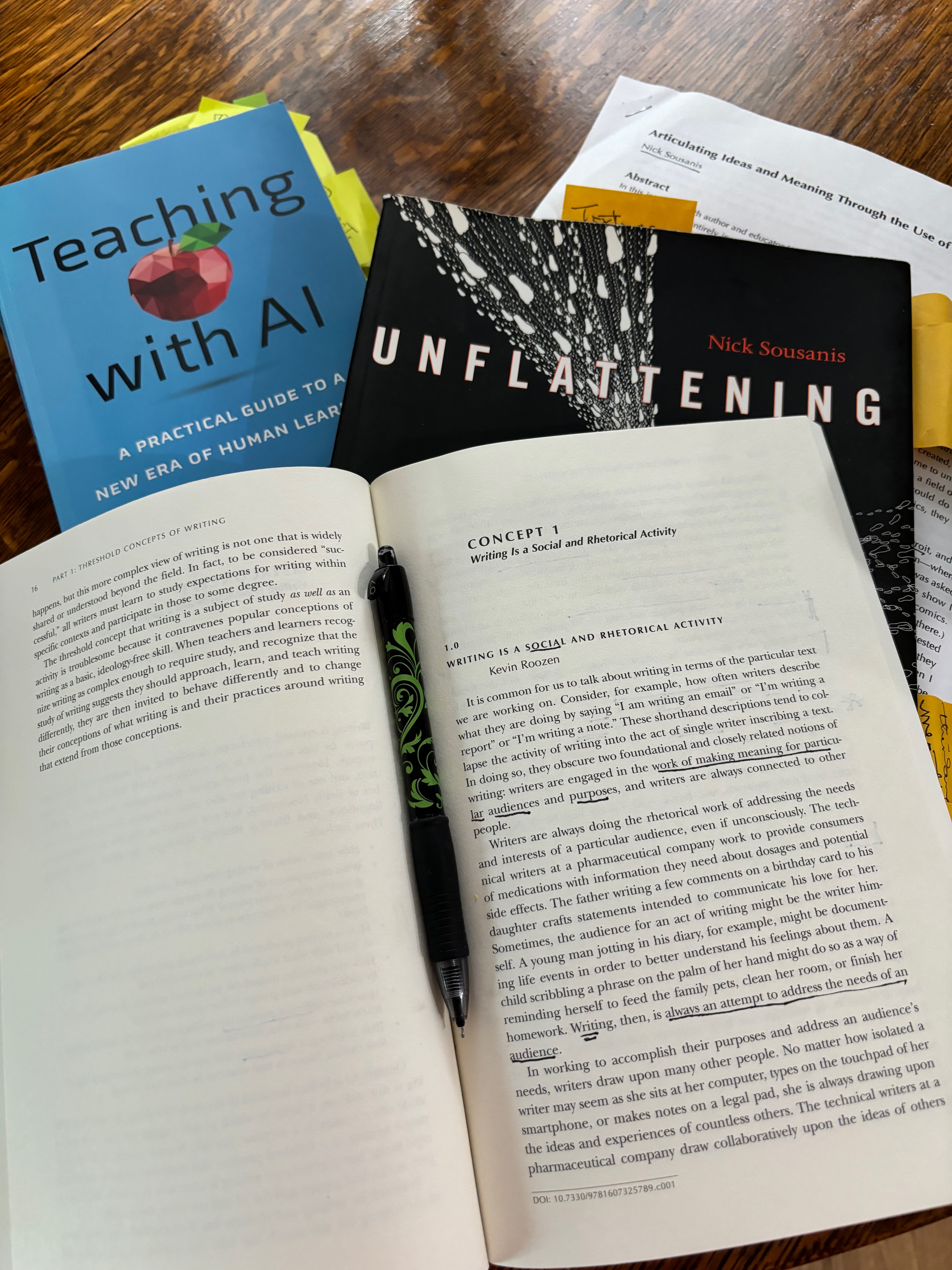
The above images are my Summer reading for teaching First-Year Writing. I read Teaching With Ai for the Advanced WAC workshop in May. My plan is to incorporate AI as an editing tool for my students. I read Unflattening in 2016 and just read an interview with the author, Nick Sousanis, yesterday. I’m now reading Naming What We Know: Threshold Concepts of Writing Studies Classroom Edition by Linda Addler-Kasner and Elizabeth Wardle. I read the first edition a couple years ago. I’m on Concept 1.0 Writing is a Social and Rhetorical Activity. Absolutely, as I write this newest post that will be shared with my social media accounts, writing is a social activity.

The second image is of the graphic memoirs I’ve read this summer that I may add to my student’s reading list. Yes, I use comics in my writing course, which relates to Nick Sousanis, a comics artist, who wrote his dissertation in comics form as the Unflattening. This morning I reread sections that I had sticky notes on. Sousanis references Plato’s dislike of images and explains “in relying on text as the primary means of formulating understanding . . .the visual provides expression where words fail . . .and what can be made visible when we work in a form that is not only about, but is also the thing itself”” (59). He explains the different names this medium has been called “comic books, graphic novels, sequential art, manga” etc. but prefers “comics.” He goes on to reference Scott McCloud’s sequential aspect of “juxtaposed pictorial and other images in deliberate sequence” and states “. . .the reader animates and transforms the static into the kinetic. . .and brings it to life,” as shown in the image below (61).

This is one of the reasons I love introducing my students to the “magic” of comics. I haven’t referenced Sousanis in several years because our textbook was a graphic text, Understanding Rhetoric an allusion to McCloud’s Understanding Comics. But a year ago, our First-Year Writing Program changed our course text to a less expansive digital eBook Let’s Talk: A Pocket Rhetoric that is not graphic. So I need a few more sources to help students understand why I incorporate comics into a writing course.

This morning, after reading the threshold concept, writing is a social and rhetorical activity and perusing Sousanis again, I was inspired, I really wanted to write a blog post. I had several ideas of what I wanted to talk about and explain because writing helps me formulate how I will present my ideas to my students. However, since this has taken all day to write I lost some of my ideas. Now that I can write in this blog again I will be posting more often this summer.

Posted in Uncategorized | Tagged , , , , | Leave a comment

Why I Say “Happy Holidays”

These are all the holidays in December.

Hanukkah

For eight days each November or December, Jews light

 a special candle holder called a menorah. 

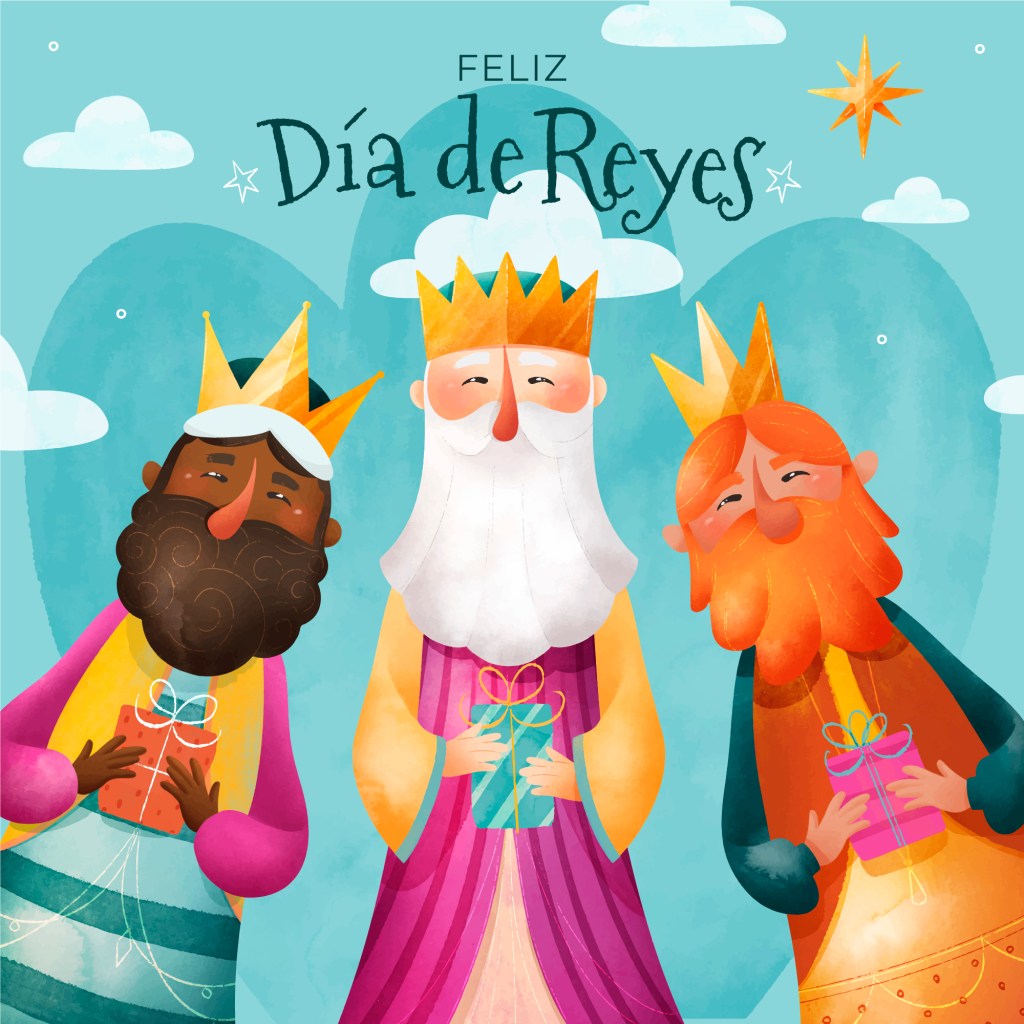
Three Kings Day

At the end of the Twelve Days of Christmas comes a day

called the Epiphany, or Three Kings Day.

Winter Solstice

The Winter Solstice occurs around December 21.

 It is the shortest day of the year.

St. Lucia Day

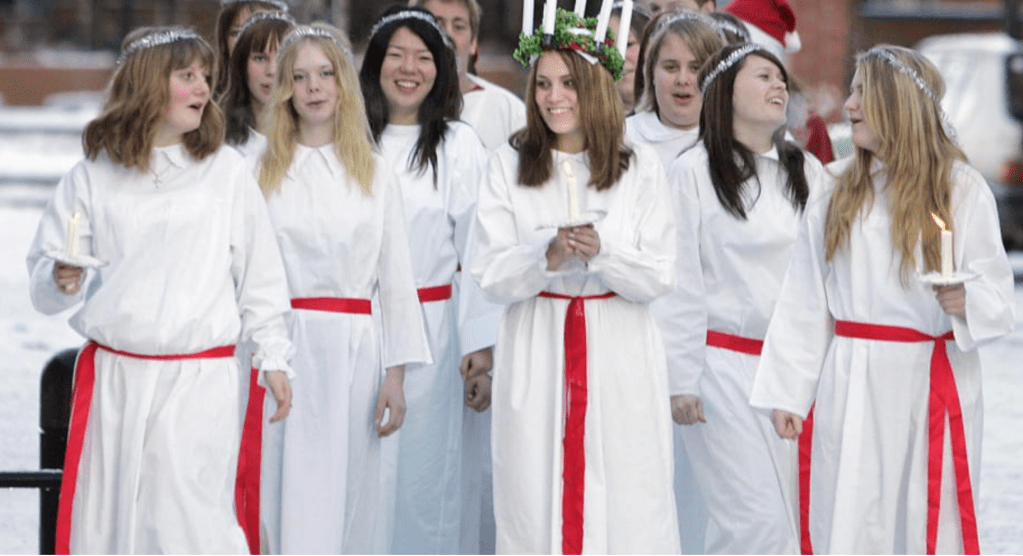
To honor this third-century saint on December 13, many girls in Sweden dress up as “Lucia brides” in long white gowns with red sashes, and a wreath of burning candles on their heads. 

St. Nicholas Day

A popular December holiday in many European countries,

St. Nicholas Day, celebrates St. Nicholas of Myra, the man whose life inspired the tradition of Santa Claus and Father Christmas.

Christmas

People celebrate this Christian holiday by going to church,

giving gifts, and sharing the day with their families. 

Kwanzaa

Kwanzaa, which means “First Fruits,” is based on ancient African harvest festivals and celebrates ideals such as family life and unity. 

Happy New Year 2023 Illustration with Gold Number and Falling Confetti on Dark Background. Vector Christmas Holiday Season Design for Flyer, Greeting Card, Banner, Celebration Poster, Party Invitation or Calendar

New Year

In Ecuador, families dress a straw man in old clothes on

December 31. The straw man represents the old year. 

Posted in Uncategorized | Leave a comment

Every Day is a Brand New Start!

This is the last line in one of my daily mantras. Being grateful for what I have instead of praying for what I don’t have is how I have lived for the last fifteen years. I don’t consider myself an atheist. I still believe there is a divine eminence, I just think in terms of a gender-neutral diety. I’ve become more spiritual instead of religious. I was a fairly faithful Episcopalian for about a quarter of a century. However, when I learned for thousands of years there was a female deity and that even the almighty God of the bible most likely had a wife, the dogma of religion totally and completely turned me off. I learned about and read many myths, legends, folktales of other cultures and realized what I had been taught was just one way of believing. So I turned to more indigenous, goddess forms of spirituality. My mantras come from a little book, Witch on the Go by Cal Garrison, I bought in 2006. I’ve revised or added to them to make them my own. Being grateful for the visible, tangible, constant aspects of life, I seemed to wake up to a new way of thinking, of believing. Every morning as I shower, bathe, or just wash my face I recite this little mantra, acknowledging life-giving water.

Water of spirit, water of life, thank you for removing all of the strive,

Out of my mind, out of my body, out of my heart

Every day is a brand new start!

It may sound silly, but as I feel the warm water on my body, or splash cold water on my face, I physically feel the stress or tension leave my body. I feel a lightness come over me and I truly am ready to meet the day.

As I said above, I live my life in gratefulness. Before I take a sip of my morning coffee, I recite another mantra to honor the four directions, the guardians, goddesses, and a divine eminence. I start by facing the east, where the sun rises, reciting the first line, and then taking my first sip of coffee then turn and repeat.

Thank you to the guardians and goddesses of the east.

Thank you to the guardians and goddesses of the south.

Thank you to the guardians and goddesses of the west.

Thank you to the guardians and goddesses of the north.

Earth mother, sky father and divine eminence.

I am receiving all good things,

my family is receiving all good things,

my friends are receiving all good things.

Thank you, thank you, thank you!

These two mantras help me keep my life in perspective, positive, and hopeful, which in these times of COVID and political divide are much needed. Both of the mantras reflect my love of nature, the earth, the sun, and the moon; the visible, tangible constant aspects of life that have been worshipped, honored for thousands of years.

Remember, every day is brand new start.

Posted in Uncategorized | Leave a comment

I’ve Been “Languishing”!

April 21, 2021

Monday afternoon while browsing Facebook, I read a New York Times article a friend posted “There’s a Name for the Blah your feeling: It’s Called Languishing”” by Adam Grant . I listened to Adam’s reading of his article this morning. He describes how I’ve been feeling lately perfectly. He says languishing is that “void between depression and flourish.” Yes, yes, yes! I haven’t written here in this blog for a couple weeks, I have two drawings, #49 and #54, on my drawing table that are not even half done. I finished a book but could not decide on what to read next. I live with my little Yorkie/Havanese, Annie Bananie, and we have our routine, but we’ve been stuck in this routine for a one year and thirty-nine days!

To top it off, It’s April in Michigan so anything can happen! And this morning we woke up to a Winter White weighing down every bush and tree. Yes, it is beautiful, but I worry about my lilac bush, will it survive? I did bring in all my plants I had in pots, so they will be fine. It is not supposed to warm up until tomorrow. This weather does not help my languishing!

Languishing, Adam says is a long-haul pandemic condition that has been brought on by COVID-19 restrictions. These “stay home, stay safe” restrictions have kept us all from visiting, traveling, shopping, going anywhere or having anyone over to visit. Yes, I have gone shopping wearing my mask. Yes, I have had my bubble of friends and family over a few times. However, I have not been on Eastern’s campus since March 11th 2020. I have survived to this point because I am a positive, creative person and I have lived alone for the last twenty-six years, since my youngest moved to California.

I learned long ago to do the things experts suggest. I make myself sit at the table to eat dinner, sometimes I even lite candles. I have a routine and a couple of mantras I recite before drinking my coffee, while washing my face, while taking a shower or soaking in the tub. I carry a talisman in my pocket. I have breathing exercises, I walk regularly in a park. I write every morning in one of my journals. And of course, I write here in this blog when the spirit moves me. Writing has been a form of therapy for me for a long time. I have a whole shelf of journals I’ve filled over the years.

So, I was moved this morning to write about this condition of “Languishing,” even the sound it makes when you say it out loud just feels like I feel. LanguishingI I’m sure there are others out there who are feeling the same. I thank Adam Grant for writing the article. Maybe sending these feelings out into the universe, the ether will help bring me out of this funk.

Maybe.

Posted in Uncategorized | Leave a comment

26-33/100 Drawing Challenge

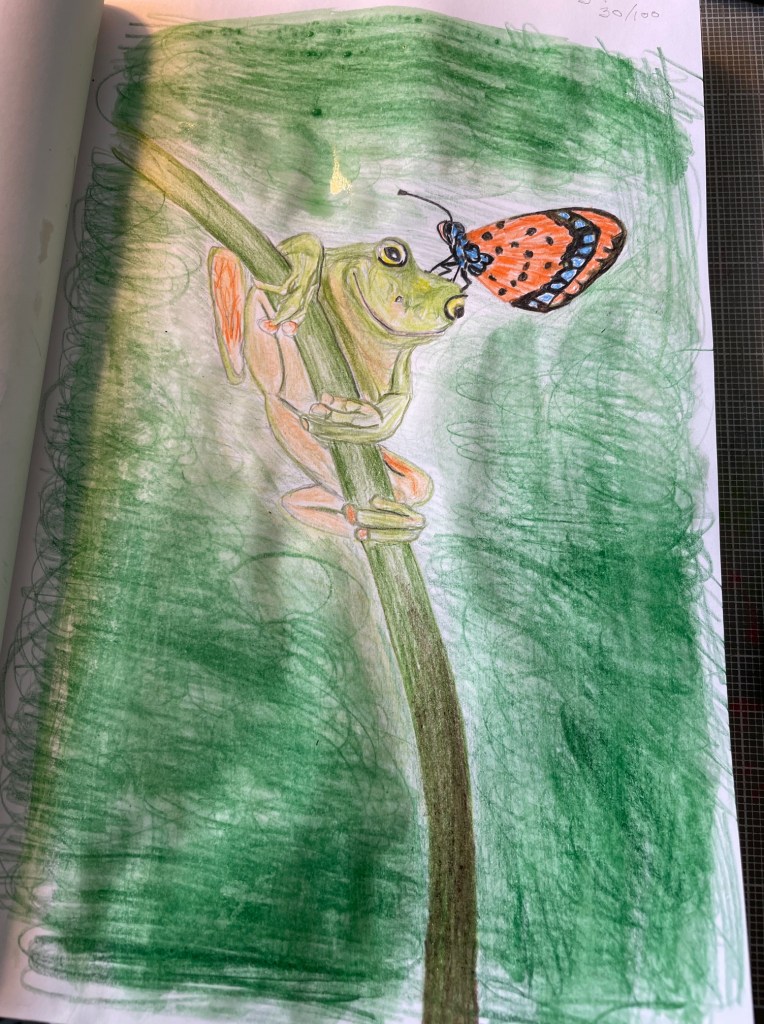
I have drawn more in the last month then I have in two years. It feels good. My biggest struggle is figuring out what to draw and if it will be just graphic or colored pencils. Some of my colored pencil are only a couple inches long, so I bought myself a new set. They are Prismacolor premier watercolor 24 count colored pencils. Below you will see the frog with a butterfly on its head where I tried to do a watercolor background. It did not work. I need to practice on separate paper.

Drawing 26 – I went back to the Petoskey stone design. I love the pattern and intricacy of the little coral shapes. I would like to do a whole series.

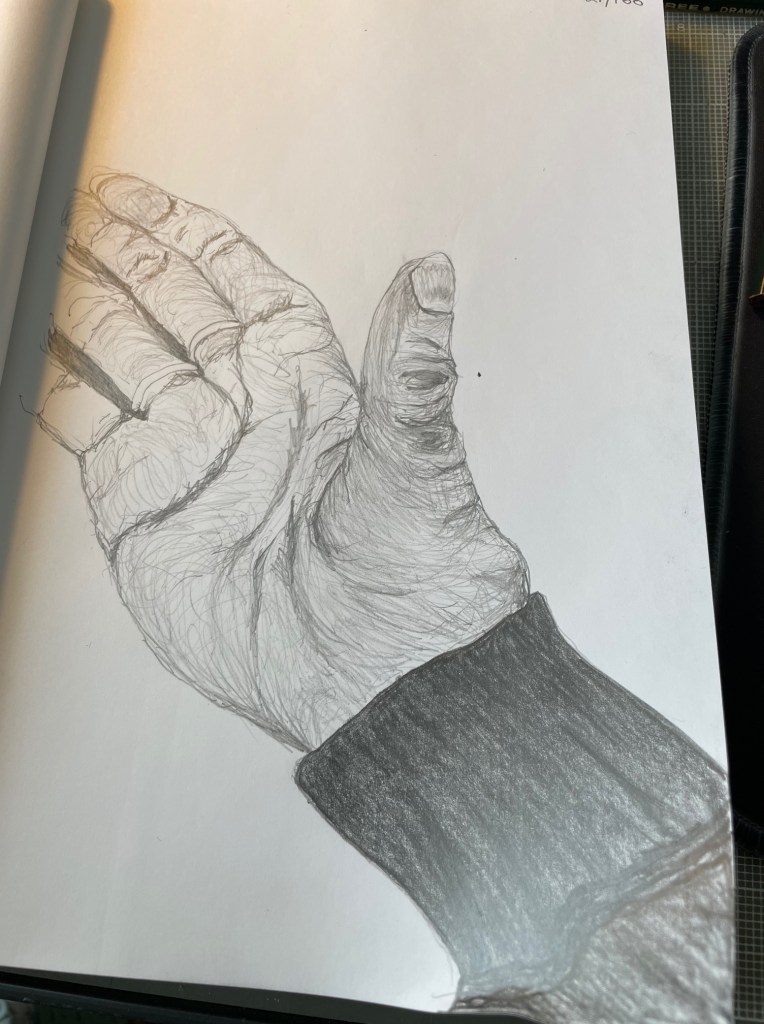
Drawing 27 – Another drawing of my right hand. This time I took a photo of the hand because it’s hard to hold it still and in the exact position for an hour or more.

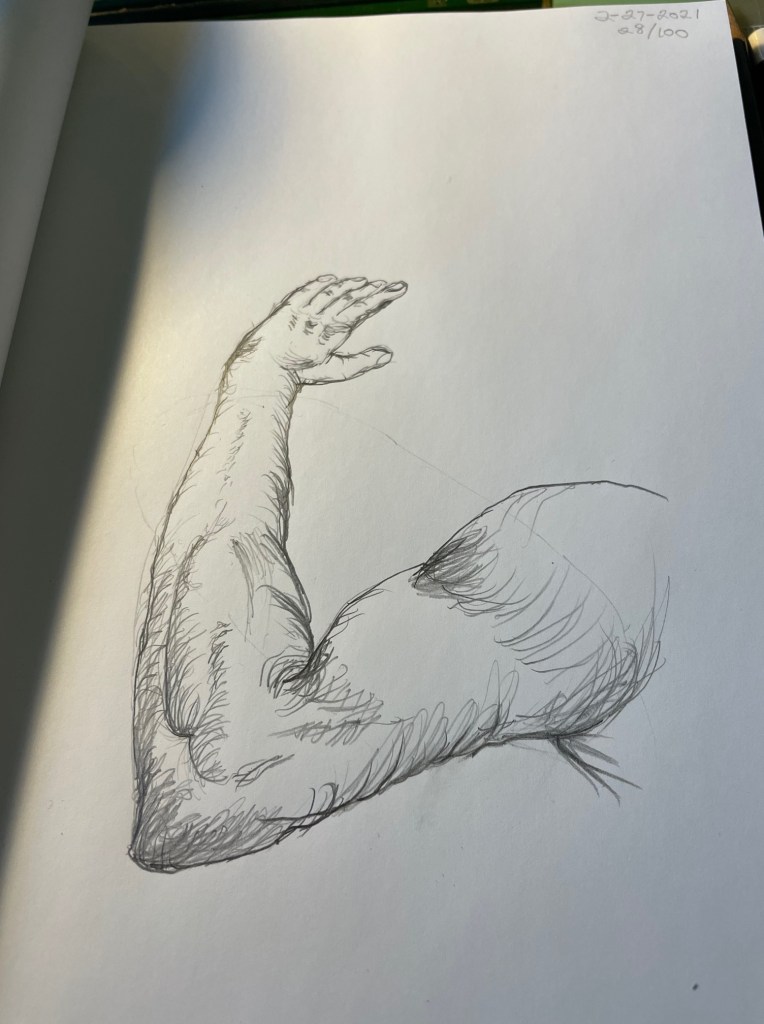
Drawing 28 – I went back to one of my drawing books for an exercise on drawing different parts of the body. I tried to draw an arm, however, the hand ended up too small. I will need to draw a lot more.

Drawing 29 – I decided to draw a turtle. I have an empty turtle shell that sits in my rock basket and I like the design pattern. I went online and found a photo of the same type of turtle so I could draw the whole turtle. My daughter and granddaughter both have turtles as pets.
Drawing 30 – I drew another tree frog with a butterfly sitting on its head. I used the new set of watercolor pencils and painted the background but it became a mess. I need a lot more practice with these pencils. I love the idea but I need to draw with these pencils on watercolor paper.
Drawing 31 – An Iguana, I was fascinated with the scales and spikes. I may do this again because the original photo is in color.

Drawing 32 – Three frogs on a branch. Yes, I seem to always go back to frogs as my subjects.

Drawing 33 – Birch Tree reflection. I took the photo last year. This is the second time I’ve tried drawing the landscape, it needs to be much darker. Maybe I will go back and darken it up.

Another week of drawing under my belt as winter begins to wane. Hang in there, spring is just around the corner.

Posted in Uncategorized | Leave a comment

19-25/100 Drawing Challenge

February 25, 2021

Today, I received my first dose of the Pfizer vaccine! My second dose is scheduled for March 18th. The COVID-19 pandemic has kept us all isolated in our homes since March 2020 and during that time we have all had to figure out how to deal with the cabin fever of a different sort. I chose to challenge myself to draw every day for a 100 days that started on Jan. 31st. Some days I do really well. Other days I find myself sitting at my drawing table staring into the ether wondering what the heck I’m going to draw today? However, I have gotten into a sort of schedule between Zoom consultations with students, written feedback consultations for students’ writing, UWC Zoom meetings, YpsiWrites Zoom meetings, WAC Speakers Presentations and Book group on Zoom, I have drawn every day for twenty-five days. I have also written here in my blog once a week. So today I write about drawings 19-25.

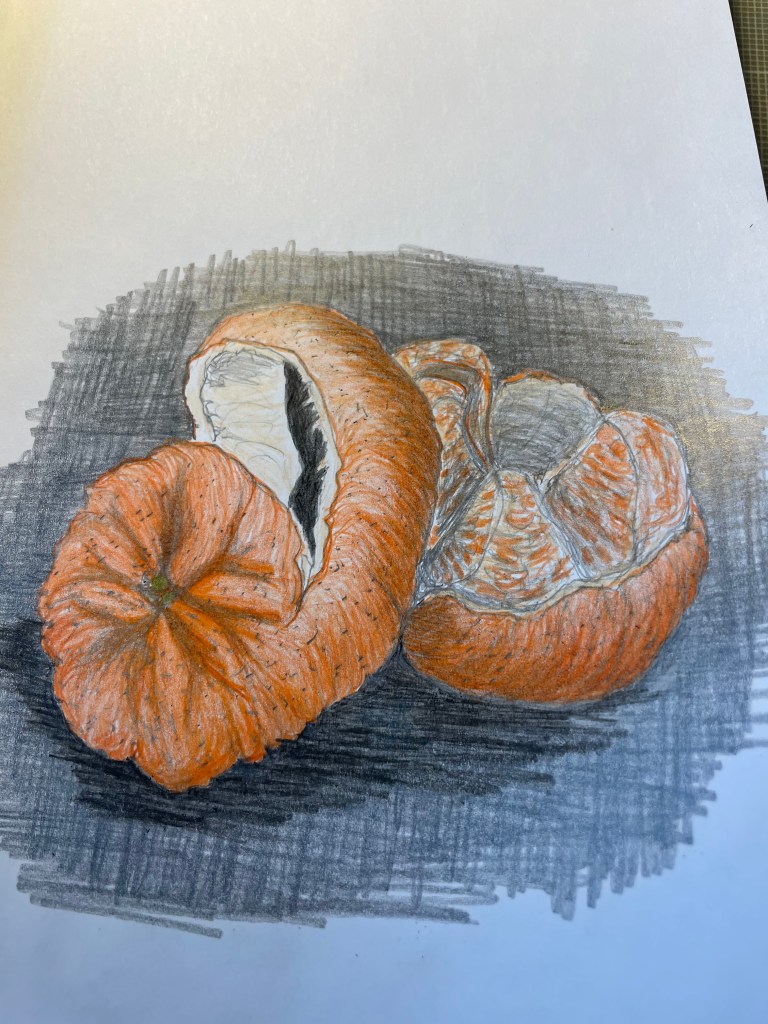
Drawing 19, I went back to the clementine. I have many photos of clementine peels and sections. About five years ago I was drawing/sketching clementines every morning. So, here is my latest version of the clementine.

Drawing 20, Yes, another frog. I have collected all kinds of frogs (like the frog necklace I wear most days), written about frogs, photographed frogs, drawn frogs for many years. My children’s book is about a pond full of frogs. I have been collecting photos of them and then I draw them.

Drawing 21, I tried to draw my right hand while looking at it. I kept moving its position. It was frustrating. It needs work.

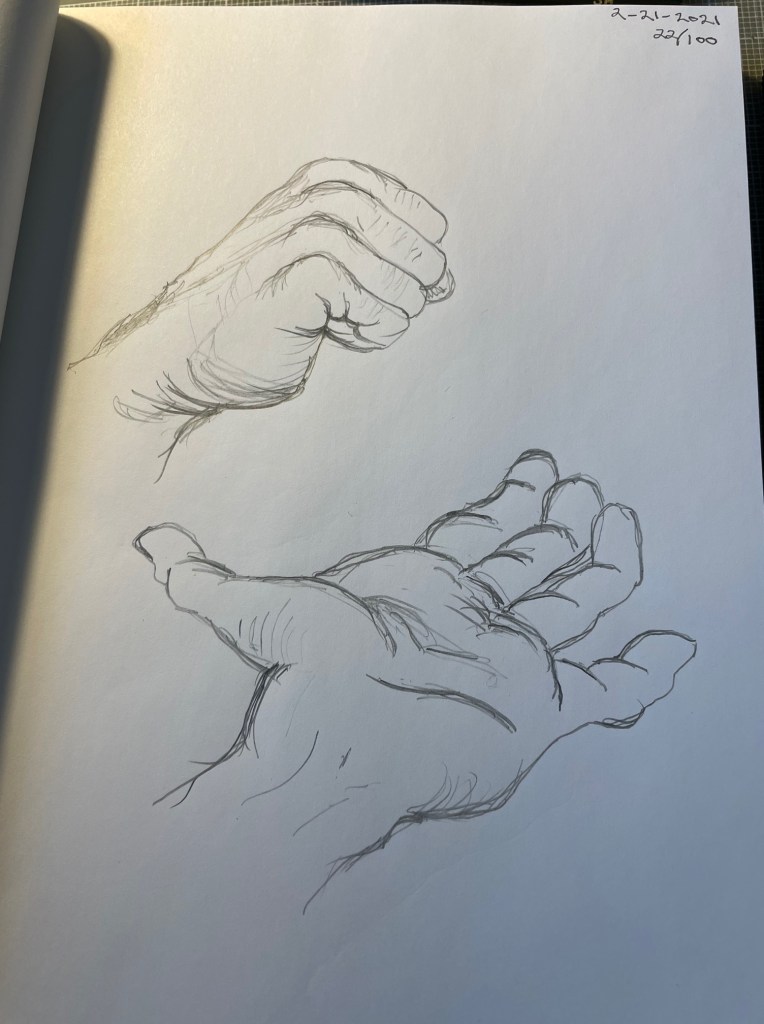
Drawing 22, I went back to the drawing book to practice hands because that is what I need to do. Draw a lot of hands.

Drawing 23, back to a little tree frog waving. I always have fun with these drawings.

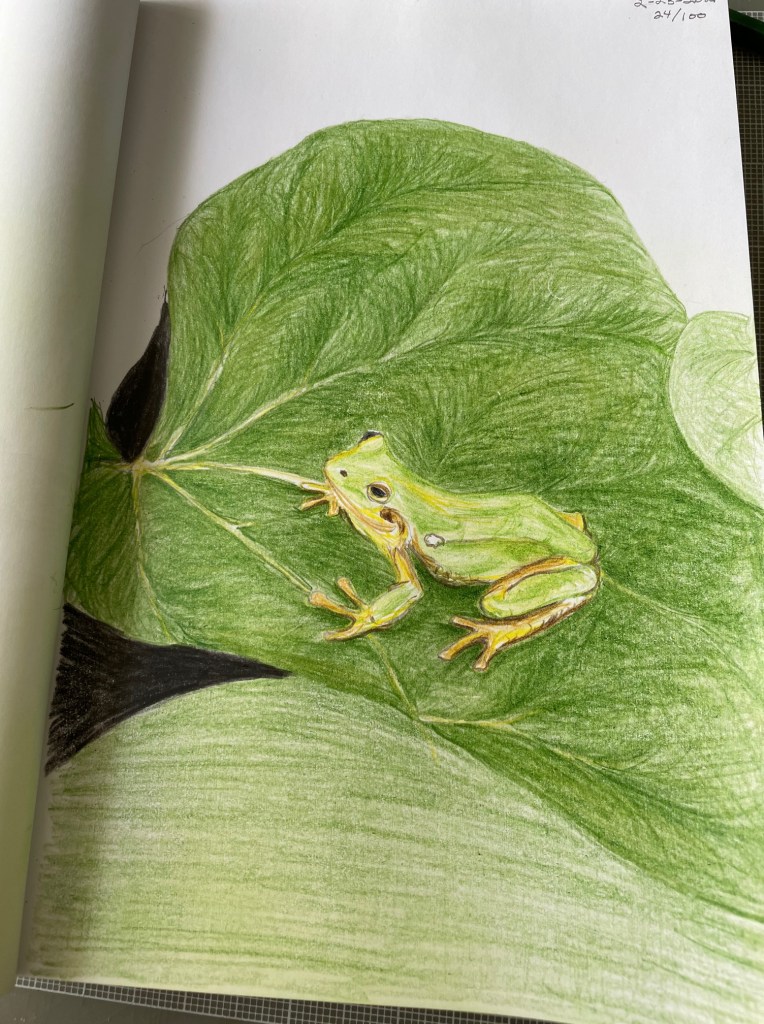
Drawing 24, another frog sitting on a big green leaf. I love shading from dark to light to indicate contours. The technique takes a lot of time and patience, however there’s great satisfaction in seeing the leaf take shape. This one has areas that work better than others, but it looks like a leaf.

Drawing 25, brought me back to trying to draw my hand again. This time I took a photo of my left hand in honor of what would have been my husband’s 76th birthday. I wear the last ring he bought me on that hand with my three children’s birthstones, along with one of the small diamonds from my original ring. The drawing still needs more work, but what should I expect of a 74 year old hand, my veins are very pronounced and the skin is wrinkly.

Now, I need to figure out what drawing 26 will be. So, until next blog post, have a great week!

Posted in Uncategorized | Leave a comment